
Most repair needs start with something obvious: a storm, a fallen limb, or a door that suddenly won't latch. What matters is what that damage did to the structure. Here's how a contractor approaches it.
After a storm, stay clear and get it checked
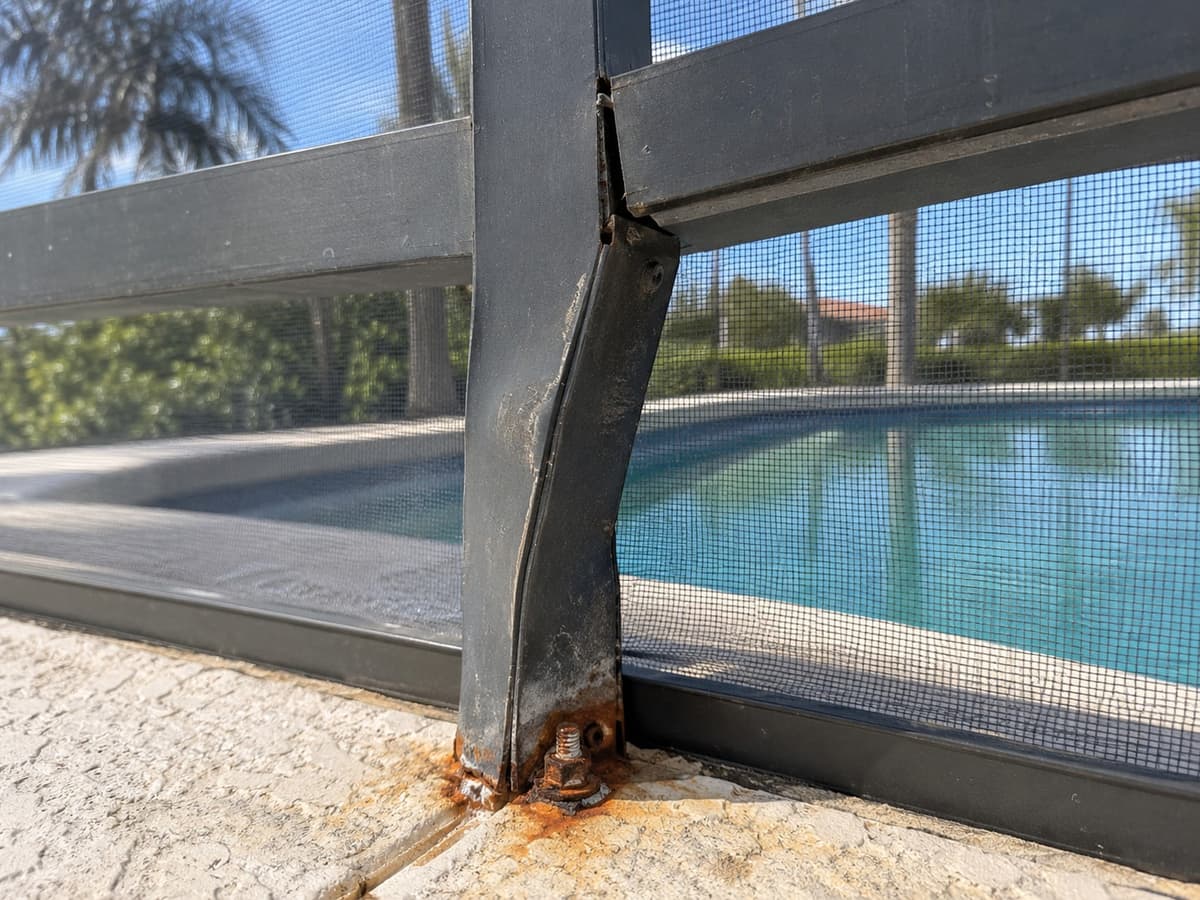
A cage with bent or leaning members can shift further in the next strong wind. Keep people and pets away from any section that looks out of line, and don't try to straighten or pull on the frame yourself. The contractor evaluates what's safe, what can be repaired, and what needs to come down. Recent hurricane seasons have put enclosures across the area to the test, which is a big part of why a frame check comes before anything else.
What pool cage repair can cover
- Bent or buckled uprights and beams
- Loose, rusted, or corroded fasteners and connections
- Bracing and cables that have loosened
- Anchors and footings that have lifted or moved
- Doors, hinges, closers, and latches
- Gutters and the connection where the cage meets the house
- Kick plates and damaged screen panels, once the frame is sound
What decides repair versus replacement
Straight aluminum, sound fasteners, and footings that haven't moved make the cage a candidate for targeted repair and rescreening. Bent uprights, corroded hardware, or a frame that has racked out of square shift the conversation toward replacement, and cost is part of that conversation too: as repairs climb toward what a comparable new enclosure would run, replacement often becomes the better value. Our repair, rescreen, or replace guide walks through the comparison in more detail.
Why torn screen doesn't tell the whole story
A cage with shredded screen can still have a sound frame, and a cage with intact screen can still have a bent beam or a loose anchor. That's why the contractor looks past the screen to the aluminum, the connections, and the footings. You describe what you noticed and when it happened. The contractor handles the evaluation.
Permits for frame work
Rescreening alone usually doesn't need a permit, but frame repairs and replacement typically do. In unincorporated Hillsborough County, the residential permit that covers pool enclosures and screen rooms is a flat $380. Pinellas County lists aluminum structures at $250 plus $1 per $1,000 of project value when no slab or footers are involved. City building departments set their own fees. Your contractor determines what's required and pulls the permit.
If you're working with insurance
If you're filing a claim, ask the contractor what their written proposal includes. A clear, itemized description of the damage and the repair can help when you talk with your insurer.
Frequently asked questions
Is it safe to use the pool if the cage is damaged?
If any part of the frame is bent, leaning, or loose, keep people away from that area until the contractor has looked at it. Torn screen by itself is mostly a bug and debris problem.
Do I need a permit for pool cage repairs?
Frame repairs and replacement typically need one. Screen only repairs usually don't. Your contractor handles the permit with the office that serves your address.
Can the screen just be replaced after a storm?
Only after the frame checks out. New screen on a bent or loose frame won't hold up, which is why the contractor evaluates the structure first.
How much does pool cage repair cost?
It varies widely with the damage. Pool screen enclosure repairs average about $925, with a typical range of $80 to $2,950 (September 2026), and significant frame damage can run higher. The contractor's written proposal sets the price for your property.
Should an older cage be repaired or replaced?
Condition decides, not age. A straight frame with sound fasteners can be repaired even if it's decades old. The contractor compares the repair scope and cost against a new enclosure before recommending either.
Related pages
Sources reviewed
Cost figures on this page were reviewed in October 2026.
- Angi, Pool Screen Enclosure Repair Cost, September 28, 2026