
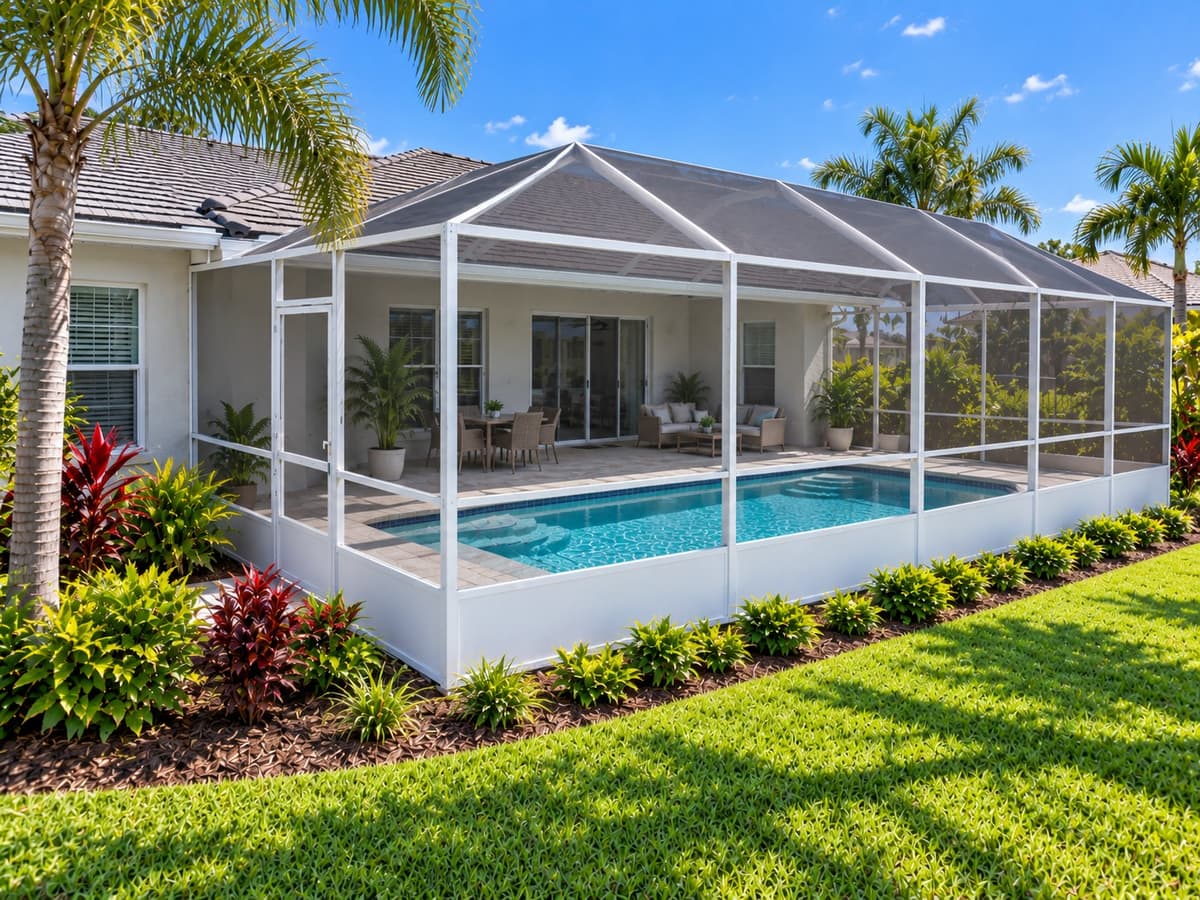
Permits are one of the biggest sources of worry for homeowners, and for most screen jobs the news is good. Here's what to know, and what your contractor handles for you.
When a permit is typically needed
- Rescreening an existing enclosure: exempt from permits in most cases.
- Frame repairs: typically need a permit.
- Replacing an enclosure: needs a permit.
- A new pool enclosure, screen room, or patio enclosure: needs a permit.
Since July 1, 2026, Florida law also exempts many single family home projects valued under $7,500 from permits. Structural, electrical, plumbing, mechanical, and gas work are excluded, as are properties in flood hazard areas. In unincorporated Pinellas County, exempt work requires a written request and approval from the building official before it starts, and the county does not inspect it.
When a permit is required, it's worth having. A permitted enclosure has had its plans reviewed and its work inspected, while unpermitted structures can create problems later, when you sell or insure your home.
Which office handles your address
Hillsborough County. Unincorporated areas go through Hillsborough County's building department. That includes Brandon, Riverview, Valrico, Wimauma, Sun City Center, and Apollo Beach. The cities of Tampa, Temple Terrace, and Plant City run their own building departments.
Pinellas County. Pinellas County Building Services handles unincorporated areas, including Palm Harbor, plus Belleair Beach, Belleair Shore, Indian Rocks Beach, Kenneth City, Oldsmar, and Safety Harbor. The county's other 18 cities, including Clearwater, Dunedin, St. Petersburg, and Tarpon Springs, run their own building departments.
What a permit costs
| Office | Fee for a screen enclosure or pool cage | Published source |
|---|---|---|
| Hillsborough County (unincorporated) | $380 flat, including a $50 application fee, plus state surcharges | Building Permit Fee Schedule, effective Oct. 5, 2024 |
| City of Tampa | $316 flat for an aluminum screen room, pool cage, or porch, plus a 2.5% state surcharge ($4 minimum) | Miscellaneous Projects Permit Fee Schedule, updated May 31, 2020 |
| Pinellas County Building Services | $250 plus $1 per $1,000 of value without a slab or footers; $350 plus $1 per $1,000 with them. Includes plan review and inspections. Plus a 2.5% state surcharge ($4 minimum) and a small technology fee. | FY26 and FY27 budgets, user fees |
| City of Dunedin | $100 plus $5 per $1,000 for work valued $5,001 to $50,000, plus plan review at 50% of the permit fee | Building Permit Fees, Appendix C, 2025 edition |
| Clearwater, St. Petersburg, Tarpon Springs, and other cities | Set by each city's own schedule | Your contractor confirms the current fee |
What the application usually involves
Hillsborough County's checklist for residential screen enclosures gives a good picture of what goes into a new enclosure permit:
- Building plans designed to the current Florida Building Code, signed and sealed by a Florida registered architect or engineer
- A site plan drawn to scale, showing property lines, setbacks, easements, and any conservation areas or wetlands
- A recorded Notice of Commencement before the first inspection
- Added requirements for properties in special flood hazard areas
Requirements vary by office, and your contractor prepares and files what's needed.
Who pulls the permit
In almost all cases, your contractor does. Screen and pool enclosures fall under Florida's specialty structure contractor license, issued through the Department of Business and Professional Regulation, and you can look up any contractor's license on the DBPR website. Florida also allows owner builder permits, but the owner then takes on the responsibilities that come with it, and Hillsborough County requires an Owner Builder Disclosure Statement.
Pool barrier rules
Florida's building code allows a standard screen enclosure to serve as part or all of a pool's safety barrier. When it does, the doors matter. Florida's pool safety law calls for pool access gates that open outward away from the pool, close on their own, and latch automatically. If you're adding or replacing an enclosure, your contractor plans for this.
HOA approval is separate
If your community has a homeowners association or deed restrictions, architectural approval is usually its own step, and it often has to happen before the permit application. An HOA approval doesn't replace a building permit, and a building permit doesn't replace HOA approval.
Frequently asked questions
Do I need a permit to rescreen my pool cage?
In most cases, no. Rescreening an existing enclosure is typically exempt. Frame repairs, replacement, and new enclosures are what usually require one.
Who applies for the permit?
Your licensed contractor, in most cases. They prepare the plans and paperwork and schedule the inspections.
How much does a screen enclosure permit cost?
In unincorporated Hillsborough County, $380. In Tampa, $316. Through Pinellas County, $250 or $350 plus $1 per $1,000 of value. All of these have state surcharges added, and other cities set their own fees.
My city isn't listed here. How do I find out?
Your contractor confirms which office serves your address and what it charges. Pinellas County also publishes a list of the building departments that serve each of its cities.
Does HOA approval replace the permit?
No. They're separate, and many associations want their approval before the permit application goes in.
Related pages
Sources reviewed
All sources were reviewed in October 2026.
- Hillsborough County, Building Permit Fee Schedule, effective October 5, 2024
- Hillsborough County, Residential Screen Enclosure and Glass Room Additions checklist, updated May 14, 2025
- City of Tampa, Miscellaneous Projects Permit Fee Schedule, updated May 31, 2020
- Pinellas County, Building and Development Review Services fees, FY26 and FY27 budgets
- Pinellas County, Building Departments in Pinellas County, updated August 11, 2026
- Pinellas County, Permit Exemptions for Work Under $7,500, updated August 3, 2026
- City of Dunedin, Building Permit Fees, Appendix C, 2025 edition
- Florida Statutes, Chapter 515, Residential Swimming Pool Safety Act, 2025
- Florida Administrative Code, Rule 61G4-15.015, Specialty Structure Contractors